The Persistence of Silence
Unraveling the Web
An interactive exploration of the Jeffrey Epstein case, based on The Sterling Review’s investigative feature. Explore the key figures, critical events, and documented evidence to understand the complex connections and unanswered questions.
The Network
Click on a figure to see their profile and highlight their connections across the timeline and evidence locker. Click the active figure again or “Clear Selection” to reset.
Donald Trump
U.S. President
Pam Bondi
Attorney General
Jeffrey Epstein
Financier
Ghislaine Maxwell
Accomplice
Interactive Timeline
Follow the case from the initial accusations to the latest developments. Events connected to a selected figure will be highlighted.
Evidence Locker
Explore the key pieces of evidence that have shaped the public’s understanding of the case. Content related to a selected figure will be highlighted.
Analysis & Stakes
Understand the political, legal, and reputational dynamics at play, and the key financial figures involved.
Political & Reputational Stakes
Trump built political capital stoking conspiracy theories about a “deep state” and promising to expose the “elite” through the Epstein files. The administration’s failure to deliver bombshells, and the DOJ’s statement that no “client list” exists, has caused a “mutiny” within his base.
Shifting statements—from promising “100% of all these documents” to calling the case a “hoax”—have undermined his credibility. Democrats have seized on the controversy, suggesting Trump’s resistance is due to his or his allies’ presence in the files.
The resurfacing of past positive statements about Epstein (“terrific guy”) and photos of their interactions continue to damage his public image, irrespective of criminal wrongdoing.
By the Numbers: Financial Web
This chart illustrates some of the immense sums of money that moved through Epstein’s network, as revealed by investigations. These figures highlight the financial scale of his operations and the resources that enabled them.
Jeffrey Epstein, Donald Trump, Pam Bondi, and the Architecture of Concealment
By Lord Viceroy Sterling
The System Protects Itsel
Jeffrey Epstein is dead. But the system that protected him lives on.
It has been more than half a decade since Epstein was found hanging in a Manhattan jail cell in August 2019, his death officially ruled a suicide. The man whose life had been wrapped in private jets, penthouse apartments, and a disturbing matrix of sexual abuse against minors exited the world in a concrete cage. But if the body was gone, the questions weren’t. Who enabled him? Who covered for him? And who else might have been part of the machinery that allowed him to thrive for so long?
Since then, his former confidante and accomplice, Ghislaine Maxwell, has been tried, convicted, and sentenced to 20 years for her role in the sexual abuse and trafficking of underage girls. But the truth—the full truth—about Epstein’s network of power, protection, and silence has remained stubbornly incomplete. The Epstein story has metastasized into something larger than one man’s crimes. It has become a study in how the American legal system bends for the well-connected, how political interests fracture public trust, and how truth becomes a casualty of delay.
This is not just a story about Epstein. It is a story about the institutions and individuals who interacted with him—sometimes tangentially, sometimes intimately—and the persistent refusal to open the full record. It is a story about former Florida Attorney General Pam Bondi and her sensational claims about “client lists.” It is a story about Donald Trump and his complex, shifting proximity to Epstein. And it is a story about secrecy—its uses, its justifications, and its dangers.
The Quiet Deal
The legal case against Jeffrey Epstein began, officially, in March 2005. That’s when the family of a 14-year-old girl went to police in Palm Beach, Florida, and reported that Epstein had molested her in his mansion. That tip launched an investigation that quickly widened. Over the next several months, Palm Beach police uncovered dozens of victims—many recruited through local high schools, all young, and all part of a disturbingly consistent pattern. Girls were paid cash to give “massages” that quickly escalated into sexual abuse. Many were asked to bring friends.
When Palm Beach investigators built their case, it was thorough. They collected interviews, confessions, and physical evidence. They surveilled Epstein’s mansion. They uncovered photos of young girls, books on sadomasochism, and signs of what officers believed to be systematic abuse.
And then, the system shifted.
Instead of charging Epstein with multiple felony counts of unlawful sex with a minor, State Attorney Barry Krischer sent the case to a grand jury—presenting only two victims. The grand jury returned a single count of soliciting prostitution, a minor charge that carried no mandatory prison time. Palm Beach Police Chief Michael Reiter was livid. He publicly accused Krischer of undermining the case. When the state declined to act, Reiter took the unusual step of turning to federal authorities.
That’s when Alexander Acosta, then the U.S. Attorney for the Southern District of Florida, stepped in. His office reviewed the evidence and, in 2007, prepared a 60-count federal indictment. But that indictment never saw the light of day.
Instead, in June 2008, Epstein agreed to plead guilty to two state charges—soliciting prostitution and soliciting a minor for prostitution. In exchange, Acosta’s office signed off on a highly unusual federal Non-Prosecution Agreement (NPA) that granted Epstein and an undisclosed list of “potential co-conspirators” full immunity from federal prosecution. The deal was made in secret. The victims were not notified. The NPA was sealed.
Epstein served just 13 months in jail, much of it on work-release. He would leave each morning and return to a private wing each evening. During this period, he reportedly continued to run his financial operations and received visitors freely. In July 2009, he walked free.
The system had not failed. It had functioned—just not for the victims
A Story Reopened
For the next decade, Epstein lived as a convicted sex offender with a vast fortune and influential social ties. The women who had once been girls launched civil suits, pursued justice in the press, and sought to void the federal plea agreement. They were stonewalled.
Then, in November 2018, the dam cracked. An explosive series by The Miami Herald, spearheaded by reporter Julie K. Brown, revisited the case in painstaking detail. The reporting reignited national outrage, focused attention on the NPA, and cast a harsh spotlight on Alexander Acosta—who by then was serving as Secretary of Labor under President Trump.
The article’s release was followed, finally, by action. On July 6, 2019, federal prosecutors in the Southern District of New York arrested Epstein on new charges of sex trafficking of minors. They argued that the 2008 NPA, agreed to in Florida, did not bind them in New York. Epstein was denied bail.
On August 10, 2019, he was found dead in his cell at the Metropolitan Correctional Center. The official cause of death: suicide. The unofficial explanation, according to a not insignificant portion of the public, was murder. Epstein’s death became a cultural event—the subject of late-night monologues, protest signs, and memes. Epstein didn’t kill himself became a rallying cry not just for conspiracists, but for anyone who believed that wealth and power shield predators from consequences.
What remained after his death was a legal vacuum and a public demand: who else was involved?
What the Files Contain—and What They Don’t
From the moment Epstein’s name returned to headlines, calls grew to “release the client list.” The idea became central to the mythology of the case: that a secret logbook of powerful men existed—proof of their complicity, perhaps even of blackmail. The reality, however, has been more opaque.
Epstein’s 2005 and 1997 contact books—commonly referred to as his “black books”—do exist and have been published in redacted and unredacted forms. They contain names and phone numbers for hundreds of people, from celebrities to royalty to political figures. They confirm association. They do not confirm participation.
Flight logs for Epstein’s private jet—the so-called “Lolita Express”—have also been released in part. These logs show that Epstein hosted many prominent passengers over the years, including Donald Trump, Bill Clinton, and others. Trump flew with Epstein at least seven times between 1993 and 1997, typically on domestic flights. Clinton flew internationally. None of the logs prove wrongdoing, but they do establish proximity—and raise questions.
The “client list” often invoked by politicians like Pam Bondi has never been confirmed to exist in a formal sense. What has been released through court records and FOIA requests are fragments: sealed testimony, civil settlements, grand jury exclusions. These fragments, when assembled, suggest something immense—but incomplete.
And into that incompleteness has flooded speculation.
Power in Proximity
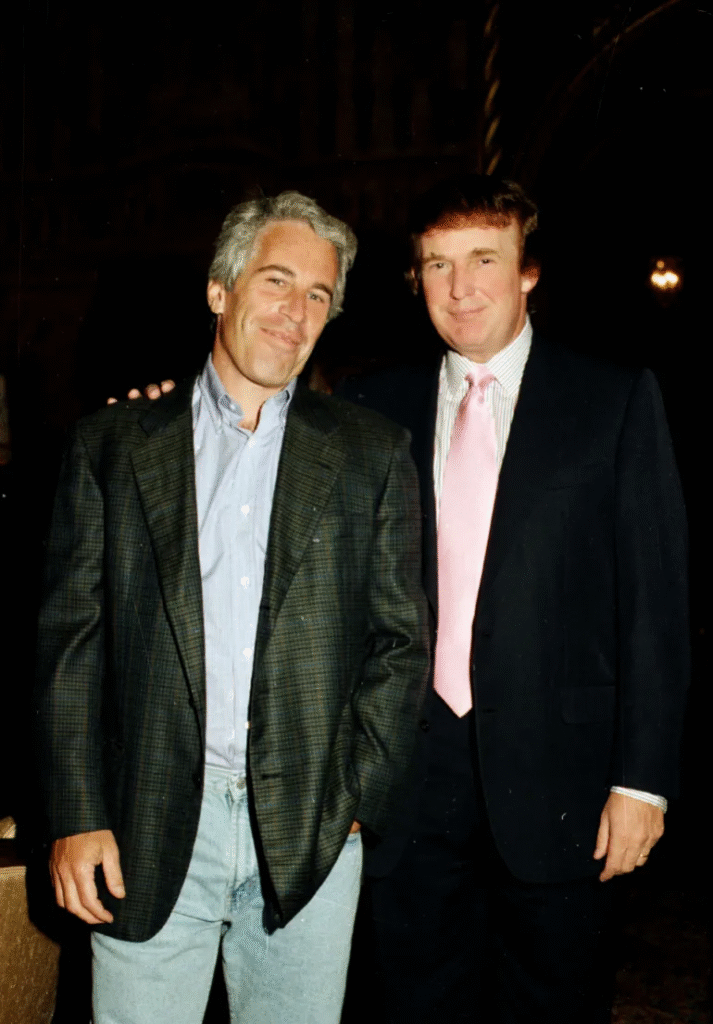
The photograph is well known by now: two men leaning in to talk, smiling. Jeffrey Epstein in a navy blazer, Donald Trump in a golf shirt. Around them, NFL cheerleaders laugh and dance at a Mar-a-Lago party in 1992. The scene is breezy, almost kitsch—until you realize what it portends. By the time that party happened, Epstein had already begun abusing girls. Within a few years, some of those girls would be speaking to police. But in that room, and in that moment, power insulated itself.
The social proximity between Trump and Epstein is not in dispute. What remains unclear—and politically radioactive—is what it meant, what it involved, and what was known. Over the years, Trump has offered several different versions of his relationship with Epstein. In 2002, he told New York Magazine that Epstein was a “terrific guy” who “likes beautiful women… on the younger side.” By 2019, he claimed they had a “falling out” and that he banned Epstein from Mar-a-Lago. By 2024, he promised his supporters that he would reveal all the Epstein files if re-elected president.
And then, in 2025, it all changed again.
A List That Was Never There
The mythos of the “Epstein client list” had, by this point, become a political tool. After Ghislaine Maxwell’s conviction, pressure mounted on the Department of Justice to release further records. Conservative activists, many aligned with Trump’s post-2020 base, claimed a “black book” or master file existed—one that could “take down the deep state.” Promises were made. Headlines crafted. Threads spun.
Enter Pam Bondi.
In February 2025, Bondi, now Attorney General in Trump’s second administration, appeared on Fox News and made a dramatic claim: “The Epstein client list is sitting on my desk right now.” The internet exploded. Hashtags surged. Conservative influencers speculated about names and implications. Behind closed doors, White House aides prepared for a media firestorm.
But when the binders were finally released a week later—disseminated during a closed-door event with right-wing media personalities—they contained almost nothing new. Court records, old media coverage, and previously unsealed documents. No names not already known. No new smoking gun.
Under pressure, Bondi walked back her comments. “There is no single client list,” she clarified. “These are DOJ case files. There are names mentioned, yes—but not evidence of criminal conduct.”
The backlash was immediate—and bipartisan. Representative Dan Goldman (D-NY) and Senator Adam Schiff (D-CA) called for Bondi to testify before Congress. Conservative pundits like Laura Loomer labeled her “a liar.” Even Trump loyalists began to fracture. If there was no list, what were they promised?
The Briefing That Changed Everything
Then came the leak. In May 2025, multiple outlets reported that Bondi and Deputy Attorney General Todd Blanche had privately briefed President Trump weeks earlier about his name appearing in the Epstein documents. The phrase used, according to sources: “unverified hearsay.” No charges. No direct accusations. Just inclusion in internal DOJ memos and case notes.
But the political damage was done. Trump had publicly denied ever being told his name was in the files. The contradiction reopened old wounds, not only about Epstein, but about trust.
A month later, Elon Musk—then an estranged former Trump supporter—posted a now-infamous tweet: “@realDonaldTrump is in the Epstein files. That’s why they’re not public.” The tweet was deleted within hours. But screenshots survived, and the sentiment hardened. Musk’s tweet wasn’t just an allegation—it was a break.
The Memo That Closed the Door
On July 7, 2025, the Department of Justice released a terse, unsigned memo. Its contents were clear: there is no “client list”; there is “no credible evidence of a blackmail scheme”; and “no further materials” will be made public. The memo cited victim privacy, the presence of child sexual abuse material (CSAM), and the integrity of sealed grand jury proceedings as reasons for non-disclosure.
Legally, the memo made sense. Morally, it felt like a betrayal. For years, the public had been led to believe that answers were coming. That the files would speak. That the secrets would surface.
Instead, the record closed with a bureaucratic whisper. The redacted names stayed redacted. The grand jury transcripts remained sealed. The binders went back in the safe.
And the base that had once demanded transparency turned inward. Some blamed Bondi. Others blamed the “deep state.” A few turned on Trump himself. The conspiracy, they now believed, had swallowed its own.
The Problem With Promises
Trump is not the only political figure associated with Epstein. Bill Clinton flew on Epstein’s plane. Prince Andrew settled a civil suit with one of Epstein’s victims. Alan Dershowitz—Epstein’s lawyer—was named in multiple lawsuits. Leslie Wexner, the billionaire behind Victoria’s Secret, granted Epstein sweeping financial control. Ghislaine Maxwell was photographed at Chelsea Clinton’s wedding.
But Trump is unique in one respect: he promised disclosure. He made the Epstein case part of his political narrative. He used it to energize his base, to frame himself as the one leader willing to “drain the swamp.” And when the files failed to deliver, the backlash was more personal than political.
The truth may be that there is no single, definitive “client list.” That most of what could be released has already been. That speculation has outpaced evidence. But the damage has already been done—because expectations, once inflated, do not deflate without consequence.
What We Know
What’s undeniable is this: Trump and Epstein shared a social world. They attended the same parties. Trump appeared in Epstein’s contact books. He flew on Epstein’s plane. Epstein attended Trump’s 1993 wedding to Marla Maples. Their paths crossed often and publicly.
The evidence does not suggest criminal collaboration—but it does suggest intimacy, at least for a time. And in high-profile scandals, perception becomes its own form of indictment.
Whether the public sees Trump’s connection to Epstein as a matter of guilt or guilt-by-association may not matter. The power of the association—photographed, logged, scribbled in a Rolodex—speaks for itself.
The Archive of Absence
There is no archive like the one that isn’t released.
In the Epstein case, the public fixation on secrecy has eclipsed almost everything else. Not the abuse. Not the plea deals. Not even the suicide. What remains most unsettling to many Americans isn’t what’s been shown—it’s what hasn’t.
The core documents of the Epstein investigation—grand jury transcripts, sealed affidavits, surveillance video inventories, internal DOJ memos—exist behind a legal architecture specifically designed to resist exposure. Federal grand jury proceedings are, by statute, secret. Investigative material tied to child pornography or minor victims is categorically shielded. Much of what remains “classified” is not technically marked as such—it’s simply buried in layers of judicial procedure.
And in that vacuum, something curious has happened. The absence has become the story. The missing files have become more potent than the released ones.
The Tweet That Changed the Narrative
In June 2025, Elon Musk—no longer CEO of anything, but still one of the most followed voices on the internet—tweeted a simple, explosive sentence:
“Trump is in the Epstein files. That’s the real reason they haven’t been released.”
The post had no link. No document. No context. It was deleted within two hours. But the damage was already done. Screenshots were captured, reposted, circulated. Cable news speculated. Digital forums erupted.
It was not just the content of the tweet that mattered—it was who posted it. Musk had, until recently, been an ally of Trump’s administration. His companies had benefitted from deregulation, favorable contracts, and tech-friendly energy policy. That he would break ranks on such a loaded topic suggested not only frustration, but betrayal.
For weeks, the tweet lingered like a ghost. Musk refused to elaborate. The White House issued a terse statement: “False, defamatory, and politically motivated.” But then, quietly, something else surfaced.
Pam Bondi, in an off-camera exchange with a conservative activist (who was wearing a hidden microphone), had confirmed that she and Deputy AG Todd Blanche briefed Trump about his name appearing in internal DOJ records. According to the transcript: “He’s mentioned a few times, nothing criminal. Hearsay. Stuff like that.”
That moment—off-script, off-camera, off-message—did more to confirm the public’s suspicions than any formal memo ever could.
The Disappearance of Evidence
Since 2019, over 100,000 pages of legal material related to Epstein and his associates have been generated through lawsuits, settlements, and criminal trials. But the vast majority remains sealed.
Much of this is standard. Victim privacy laws are strict. Child sexual abuse material cannot legally be shown or referenced in public filings. But beyond that, a pattern has emerged: of lost records, redacted logs, and unexplained deletions.
Epstein’s in-custody death was itself a procedural implosion. The security cameras outside his cell allegedly malfunctioned. The guards falsified logs. The prison’s surveillance hard drives were “accidentally overwritten.” Every stage of the investigation has included a technical failure that, on its own, might be explained—but together suggests something more systemic.
One former FBI agent, speaking anonymously, said it plainly: “This is the most documented, least understood case I’ve ever seen.”
The FOIA Labyrinth
Dozens of Freedom of Information Act (FOIA) requests have been filed by journalists, advocacy groups, and legal scholars seeking access to Epstein-related records. Most are denied. Some are partially fulfilled—with entire pages redacted. Others are simply delayed until “ongoing investigations” conclude. But no one can say what those investigations are.
In 2024, one FOIA lawsuit finally compelled the Department of Justice to release internal emails discussing Epstein’s death. What came out were pages of backdated emails, calendar entries, and internal briefings. But the most sensitive content had been redacted with the catchall classification: b(7)(A)—“interference with law enforcement proceedings.”
It’s a catchphrase that can stretch as far as the government needs it to. And in the Epstein case, it has become a shield of indefinite duration.
The Culture of Disappearance
The Epstein case has revealed a profound shift in how the public relates to information. Once, we believed the release of facts could resolve suspicion. That sunlight was, as Justice Brandeis famously wrote, “the best disinfectant.” But in the digital age, the inverse seems more true: absence breeds obsession.
Every blank page, every black box, every blurred name becomes an invitation. The public no longer waits for disclosure. It fills in the blanks on its own. Through Reddit, through TikTok, through anonymous leaks and AI-assisted voice analysis of old flight manifests. The crowd becomes its own archivist—and its own executioner.
Some of that is dangerous. It leads to false accusations, misread names, ruined reputations. But the institutional refusal to speak plainly has made that void inevitable.
If the government won’t say what it knows, the internet will say what it wants.
Absence as Evidence
The most important documents in the Epstein case may never be released. The federal grand jury that reviewed his conduct in Florida produced transcripts that remain under seal. The surveillance footage recovered from his Manhattan townhouse—reportedly thousands of hours—remains classified. The identities of the “potential co-conspirators” protected under the 2008 NPA have never been fully disclosed.
What has emerged instead is a pattern: every time the public is promised transparency, it receives only summary denials. Every official who assures justice also withholds the documents that would support it.
And that may be the most corrosive truth of all.
Because in an era defined by conspiracy, the refusal to speak is its own form of confirmation.
The Network That Remains
Long after Epstein’s death, long after the media turned away from grainy photos and flight logs, the question lingers: How did he do it? How does a high school dropout with a history of financial fraud build a network that spans billionaires, royals, ex-presidents, and prime ministers—without being stopped?
The answer is not Epstein himself. It is the scaffolding that surrounded him.
His story is no longer only about crimes; it’s about complicity. The kind that doesn’t require a signed check or a knowing wink. The kind that happens when people who could have asked questions chose not to. When institutions looked the other way. When social capital mattered more than criminal suspicion.
Epstein was the avatar. The system that enabled him is still intact.
The Wexner Question
For decades, Leslie Wexner—founder of L Brands, owner of Victoria’s Secret, and one of the wealthiest men in Ohio—was one of Epstein’s closest associates. It was Wexner who granted Epstein power of attorney in the 1990s. Wexner who sold him the Manhattan mansion on East 71st Street for just $10. Wexner who remained silent when questions began to emerge.
In 2022, a class-action lawsuit filed by former Victoria’s Secret models alleged that Epstein used his relationship with Wexner to lure women into exploitation. While the suit was ultimately settled—with no admission of wrongdoing—it raised deep questions about the line between business relationships and social sponsorship.
Wexner has repeatedly denied knowledge of Epstein’s criminal behavior. But as former L Brands executives have testified in sealed depositions, the relationship was “unusual,” “overlapping,” and “closer than anyone understood.”
There is still no public investigation into Wexner’s role. No subpoena. No hearing. No statement. Just a silence that deepens with each passing year.
The British Connection
In January 2022, Prince Andrew paid a reported £12 million settlement to Virginia Giuffre, one of Epstein’s most prominent accusers. The payment came without any admission of guilt, and included a clause barring future civil action. Buckingham Palace promptly stripped him of his military titles and official patronages.
But the damage was already done.
Prince Andrew’s BBC interview, in which he claimed he could not sweat and had never met Giuffre despite photographic evidence, became a cultural punchline. Yet no criminal charges were ever filed. No further investigation undertaken. And no other royal figures scrutinized.
In Britain, the Epstein case became not a reckoning—but a sideshow. A constitutional embarrassment, quickly managed and just as quickly forgotten.
Ghislaine’s Silence
When Ghislaine Maxwell was convicted in December 2021 on five counts of sex trafficking and conspiracy, many expected a wave of disclosures. She had been Epstein’s gatekeeper for decades. She knew the logistics. She knew the clients. She had, by all credible accounts, recruited girls, booked flights, and curated introductions.
But since her conviction, Maxwell has spoken only once: a jailhouse interview in 2023 where she denied ever harming anyone, called Epstein’s death “suspicious,” and promised to appeal.
She has not named names. She has not cooperated with prosecutors. And the DOJ, it seems, has not pressed her to.
It’s unclear why. Some speculate that she retains leverage. Others argue she is protecting powerful figures. Still others believe she has nothing more to give—and that the case against her was the final chapter, not the first.
But for victims, advocates, and the public, her silence is a scream.
The Institutions That Failed
Everywhere you look in the Epstein story, there is an institution that could have acted sooner:
- The Palm Beach Police Department, which investigated Epstein in 2005, assembled a robust case, and was overruled by the State Attorney’s Office.
- The U.S. Attorney’s Office in Miami, which signed the now-infamous 2008 non-prosecution agreement shielding “potential co-conspirators.”
- The Department of Justice, which failed to notify victims, as required by the Crime Victims’ Rights Act.
- Harvard University, which accepted $9 million in donations from Epstein even after his conviction.
- MIT Media Lab, which funneled donations from Epstein through third-party proxies to avoid detection.
- The media, which in many cases ignored the story until it was too big to deny.
These are not merely footnotes. They are the system. And they remain largely unreformed.
The Cost of Looking Away
In the years since Epstein’s death, over 30 women have filed lawsuits against his estate. Many have settled. A few remain pending. But even as compensation is negotiated, justice remains elusive.
What does justice look like when the perpetrator is dead? When the network that enabled him refuses to name itself? When institutions see no incentive to change?
For most of Epstein’s victims, the answer is simple: accountability. A full public reckoning. Not just of the man—but of the culture that made him possible.
That reckoning has yet to arrive.
The Lie of Transparency
It’s an idea as old as democracy itself: that governments serve the governed by telling the truth. That sunlight cures corruption. That open records and open courts are the lifeblood of accountability.
But the Epstein case has become the exception that proves the rule—and then breaks it.
Despite being one of the most high-profile criminal sagas of the 21st century, it has delivered precious little in the way of transparency. Instead, it has become a masterclass in institutional silence. Not just what is hidden, but how it’s hidden. Not just who is complicit, but how complicity is coded into policy.
The phrase most often used is “ongoing investigation.” But what investigation? Into whom? On what grounds? With what timeline? Those questions are never answered. Instead, agencies issue carefully worded press releases that promise clarity just around the corner—only to change the subject when the corner comes.
This is not a failure of communication. It is the architecture of secrecy itself.
Redactions by Design
It is one thing to protect victims. It is another to redact entire documents for reasons unrelated to safety. Time and again, public records in the Epstein case have been withheld not for privacy—but for “institutional integrity,” “national security,” or “prosecutorial discretion.”
In January 2025, when Judge Loretta Preska unsealed a tranche of previously sealed civil case documents, she noted that many names were still hidden—not because they posed any threat, but because the parties involved had “not been criminally charged.” This logic is legally defensible—but ethically fraught.
It creates a hierarchy of disclosure. If you were powerful enough to avoid prosecution, your name stays hidden. If you were vulnerable enough to be victimized, your identity might be publicized through court filings, media reports, or leaked transcripts.
In a just system, power would not be the shield. But in the Epstein case, it often was.
The Deference Machine
The American legal system is filled with language that sounds impartial but functions as insulation: prosecutorial discretion, judicial economy, national interest.
These are not bad doctrines in themselves. They exist to balance competing needs: justice and efficiency, privacy and disclosure. But in cases like Epstein’s, they are too often deployed to prevent embarrassment—not to serve the public.
The 2008 non-prosecution agreement signed by then–U.S. Attorney Alexander Acosta is a prime example. It shielded not only Epstein, but “any potential co-conspirators.” The names of those co-conspirators were never made public. Nor were the emails showing how Epstein’s lawyers lobbied for this clause—emails which later revealed that DOJ attorneys sought to avoid a “firestorm” by keeping victims uninformed.
When that story broke in 2018, Acosta defended himself by saying it was “the best deal we could get.” But what he didn’t say was why no one tried harder. Why no one thought the victims deserved more. Why silence was chosen as the easier path.
Congressional Cowardice
In the wake of Epstein’s death, several members of Congress promised hearings. Bills were drafted. Letters sent. In 2020, Senators Ben Sasse and Chuck Grassley demanded answers from the Bureau of Prisons. They received platitudes.
In 2021, House Democrats introduced legislation to strengthen victim notification procedures under the Crime Victims’ Rights Act. It died in committee.
In 2023, a bipartisan coalition pushed for the DOJ to review Epstein’s plea deal. The department declined.
By 2025, the political appetite had faded. The files remained sealed. The grand juries remained closed. And no sitting member of Congress, Republican or Democrat, was willing to re-open the door.
What does it say about our institutions that a case involving global trafficking, political elites, and dozens of victims cannot secure a single day of public testimony?
The Myth of Accountability
We are taught that systems self-correct. That journalism exposes. That courts adjudicate. That the public, when outraged, forces reform.
But the Epstein case reveals the fragility of that belief.
At every turn, individuals made decisions—quiet, bureaucratic decisions—that added up to systemic silence. A court sealed the plea agreement. A prosecutor declined to indict. A university cashed the check. A judge permitted redactions. A senator declined to push.
No one event sealed the truth away. It was sealed, brick by brick, by the very people who claim to protect it.
This is not conspiracy. It is bureaucracy.
And it is far more dangerous than a conspiracy—because it is legal.
The Burden of Knowing
Those who watched Epstein walk in and out of the courthouse in Florida in the late 2000s knew. Those who shook his hand at charity events knew. Those who booked his flights, scheduled his meetings, paid his bills—they knew something. Maybe not everything. But enough.
And in the years since, many of those people have faced no consequence. They remain in boardrooms, on advisory panels, in government positions. They are the respectable face of power.
They are what impunity looks like in America.
What Justice Still Demands
It is tempting to believe that the Epstein story is over. That with his death, with Ghislaine Maxwell behind bars, and with high-profile settlements paid, the arc has reached its grim conclusion. But justice is not a matter of optics or fatigue. And it does not retire when the headlines fade.
Justice—real justice—requires more than a prison sentence. It requires a confrontation with what allowed a predator to thrive in plain sight. It requires systems to name their own failures. And it demands that power no longer shield itself behind silence.
As of 2025, that reckoning has not arrived. But it could. The choice is still open.
Naming Is Not Vengeance
Some argue that unsealing documents, naming names, or revisiting old relationships is an exercise in vengeance. That the past is best left buried. That it’s time to move on.
But naming is not about revenge. It’s about narrative repair.
For years, Epstein’s victims were told they didn’t matter. That their memories were not reliable. That their stories were disruptive to more important men. And when their stories were finally heard, they were still forced to watch as others—those who attended Epstein’s dinners, accepted his money, flew on his planes—were allowed to skate away untouched.
To name someone’s role in that network is not to accuse them without evidence. It is to acknowledge the system that protected Epstein was full of willing participants—many of whom remain hidden only by institutional cowardice.
Justice begins with saying who did what. Even if prosecution is impossible. Even if memory is all that remains.
The Right to Truth
Across the world, truth commissions have long recognized that justice and punishment are not the same. In countries recovering from dictatorship or apartheid or genocide, courts have often failed—but truth-telling has not.
The Epstein case may not be the Holocaust. But it is part of a larger pattern—of elite networks shielding each other from scrutiny, and of legal frameworks being manipulated to suppress the full record.
There is precedent for breaking this silence. A public inquiry. A congressional commission. A national registry of sealed cases involving known abusers. A database of donations linked to convicted traffickers. Civil recourse for survivors to depose those previously protected by immunity deals.
None of these things require new laws. They require political will.
The Survivor as Historian
In the absence of official reckoning, it has been the survivors who have carried the archive. Virginia Giuffre, Sarah Ransome, Maria Farmer—women whose testimony was once dismissed, now serve as the primary historians of this era.
They are the ones who remember who sat on Epstein’s couch. Who flew to Zorro Ranch. Who made the call to “fix it quietly.”
And they are the ones who are still waiting.
Waiting for full disclosure. Waiting for acknowledgment. Waiting for their country to say, unambiguously, that they were not imagining it. That the system failed them. That the silence will end.
Reckoning Without Illusion
No single trial, document, or revelation will satisfy the scale of what was lost. But absence should not become an excuse. Justice is not measured by completion—it is measured by effort.
- Release the files.
- Name the names.
- Explain the redactions.
- Tell the public why accountability stalled.
- Ask the institutions that failed to say so—publicly, in writing, on the record.
That is not vengeance. That is what adults owe to one another in a functioning democracy.
A Mirror Held Up
In the end, the Epstein case is not just about Epstein. It is about us.
About the kind of society we have built—one where power apologizes only under subpoena, and institutions preserve their image at the expense of their integrity.
It is about what we tolerate in exchange for proximity to wealth. What we dismiss to avoid confrontation. What we forget to preserve comfort.
And it is about whether we are capable, even now, of telling the whole story.